For owners, plant heads and ERP project leads in manufacturing
Roll out ERPNext in your factory without the usual chaos.
A practical, phase-by-phase roadmap with exit criteria, templates, UAT scripts and a cutover runbook, written for Indian MSME manufacturers and drawn from ERPNext documentation and published implementation guidance.
₹12,000 ₹2,400
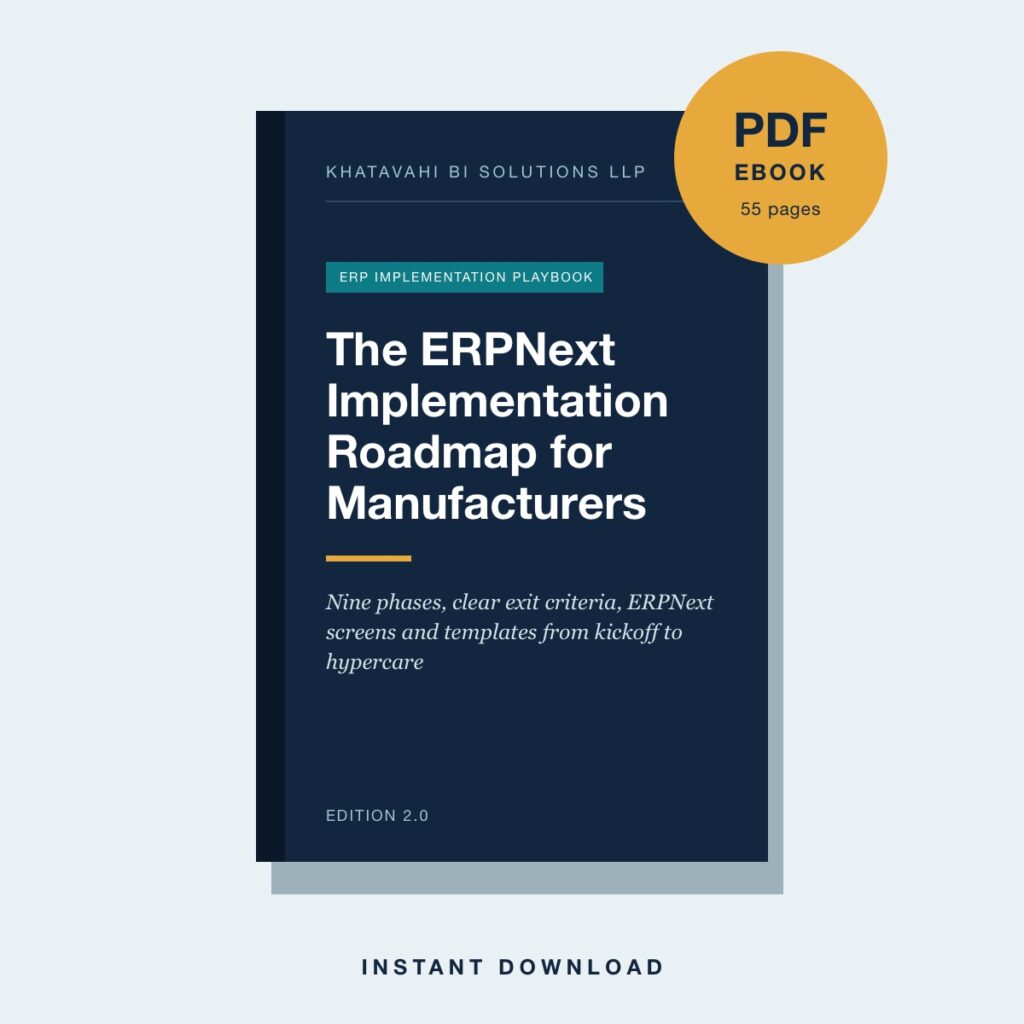
- 55-page PDF
- Instant download
- Nine phases with exit criteria
- Templates and checklists
Most ERP projects struggle long before go-live
Scope grows and dates slip
A go-live date is fixed before the work is understood, so testing shrinks as the date gets closer.
Nobody owns the data
Duplicate items, missing units and bills of materials that live in people's heads make the new system untrustworthy from day one.
The consultant tests the consultant's work
Without business users running scripted tests, problems surface on the shop floor instead.
Go-live day becomes the rehearsal
Opening balances, stock counts and cut-over steps are tried for the first time with real orders waiting.
The team quietly resists
Training is a one-off session, nobody is coaching, and the old registers never really stop.
A stalled implementation costs more than the software ever did: lost months, frustrated staff, and a team that stops believing the system will help.
A plan you can follow, with proof at every gate
The roadmap breaks the project into nine phases. Each one tells you what to do, who owns it, which ERPNext screens and settings are involved, and the evidence that says you are ready to move on.
What you will be able to do
- Set measurable goals and record the baseline, so you can prove the benefit later.
- Agree scope, build the team and run governance that keeps the sponsor involved.
- Document processes, review fit and gap, and keep customisation under control.
- Secure the system with roles, module profiles and segregation of duties.
- Prepare and load clean master data: items, warehouses, parties, BOMs and prices.
- Build BOMs and routings, and understand how ERPNext costs a product.
- Run a pilot, scripted acceptance tests and a rehearsed cutover with opening balances loaded in the right order.
- Track the right KPIs after go-live, including OEE and inventory accuracy.
What is inside
- Why Manufacturing ERP Projects Succeed or Fail The patterns that decide the outcome before the first screen is configured.
- Phase 0: Readiness, Scope and Business Case Goals, baseline KPIs, scope matrix, team, governance and a compliance calendar.
- Phase 1: Process Discovery and Blueprint Walk the floor, write one-page blueprints and run the fit-gap review.
- Phase 2: Foundation and Access Governance Staging site, roles, module profiles and segregation of duties.
- Phase 3: Company, Taxes, Warehouses and Master Data Warehouse design, data rules, import order and mock loads.
- Phase 4: Engineering Data BOMs, routings, costs and the Manufacturing Settings that matter.
- Phase 5: Buying, Stores, Production, Quality and Dispatch Procure to stock, subcontracting, planning, work orders and GST documents.
- Phase 5: Run a Real Pilot Pick, run and score a pilot on one product family.
- Phase 6: Training and User Acceptance Testing Role-based training, change management and scripted UAT.
- Phase 7: Cutover and Go-Live Cutover timeline, opening balances, physical count and go/no-go checklist.
- Phase 8: Hypercare, KPIs and Continuous Improvement Stabilise, measure and keep improving.
- Templates and Tools 24-week plan, 12-visit rhythm, risk register, RACI and charter outline.
- Sources and Further Reading Every source listed, and what to verify before you rely on it.
Indian context included: MSME classification, GST e-invoicing and e-way bill checkpoints. Statutory rules change, so the guide tells you what to verify.
This is for you if
- Owners and directors planning an ERPNext rollout in a discrete, process, job-work or hybrid factory.
- Plant heads and department leads who will be asked to own parts of the project.
- Consultants who want a repeatable plan and templates for clients.
This is not for you if
- Pure trading businesses with no production. Parts will help, but the roadmap is built for manufacturers.
- Anyone looking for server installation steps. See the VPS guide instead.
The ERPNext Implementation Roadmap for Manufacturers
₹12,000 ₹2,400
- Instant PDF download after purchase
- Read on any phone, tablet or computer
- Download link on your order page and in your email
Questions
Who is this roadmap for?
Owners, plant heads, department leads and consultants planning an ERPNext rollout in discrete, process, job-work or hybrid manufacturing, with Indian MSMEs in mind.
How long does an ERPNext implementation take?
It depends on your size and how ready your data is. The roadmap gives planning guides and a sample 12-visit plan. Owner-led single-site plants often plan three to six months to a first go-live.
What templates and checklists are included?
A process blueprint template, data sheet columns, UAT scripts and scenarios, a cutover timeline and go/no-go checklist, a risk register, RACI, a 24-week sample plan, a 12-visit plan and KPI definitions.
Is it tied to an ERPNext version?
No. It covers planning, data and people work that applies across versions. Screen names follow the current documentation.
Does it cover GST and e-way bill?
It covers tax set-up in master data, such as GST templates and HSN or SAC codes, and e-way bill in dispatch as part of process design. Always confirm current rules with your tax adviser.
How do I get the ebook?
After checkout, a download link appears on your order page and in your order email.