
A world that refuses to stay predictable
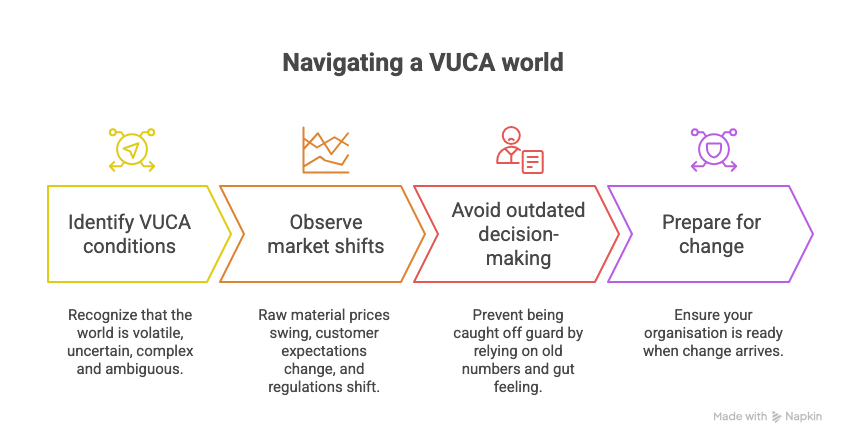
The world today is volatile, uncertain, complex and ambiguous. Management thinkers call this VUCA, and every business owner now lives it.
Raw material prices swing within weeks. Customer expectations change faster than product cycles. Regulations, taxes and supply routes shift with little warning. Even a well-run organisation can be caught off guard when decisions rest on old numbers and gut feeling.
The question is no longer whether change will arrive. It is whether your organisation will be ready when it does.
Becoming future ready is a process
Being future ready is not a project you finish or a tool you buy once. It is a continuous process of building the ability to sense change, decide quickly and adapt without chaos.
Organisations that do this well share three habits:
- They see their business clearly, in real time.
- They decide on facts, not assumptions.
- They change processes quickly because their data and workflows are connected.
Every one of these habits depends on one thing: reliable data. That is where the process begins.
Step one: digital transformation
The first step in this process is digital transformation. It means moving your organisation from scattered files, paper registers and disconnected tools to a single digital way of working.
Many owners think digital transformation means a website, an app or a few new gadgets. Those help, but they are not the foundation. Real transformation starts when the information that runs your business is captured, stored and used digitally, every day, by every team.
And that starts with putting in place a system that tracks all the data related to your organisation.
Why ERP implementation is a must
Enterprise Resource Planning (ERP) software is that system. It brings the whole organisation onto one platform, so every transaction is recorded once and visible to everyone who needs it.
A good ERP tracks:
- Sales and purchase: quotations, orders, invoices, supplier bills and payments
- Inventory and production: stock levels, batches, work orders and costing
- Accounts and finance: ledgers, receivables, payables, taxes and budgets
- People: attendance, payroll, leave and performance
- Customers: leads, follow-ups, service requests and history
Without it, each department keeps its own spreadsheet and its own version of the truth. Owners wait for month-end reports that are already out of date, and nobody can answer a simple question such as “how much stock do we really have?” with confidence.
With ERP, that data lives in one place. You cannot be future ready with data you cannot trust, which is why ERP implementation is not optional.
How ERP answers each part of VUCA
ERP does not remove volatility, but it gives you the visibility and speed to handle it.
| VUCA | What you face | How ERP helps |
|---|---|---|
| Volatility | Prices, demand and costs change fast | Live dashboards and costing show the impact of a change today, not next month |
| Uncertainty | Outcomes are hard to predict | Historical data and reports support forecasting, reorder levels and budgets |
| Complexity | Many products, branches, taxes and teams | One connected system replaces many disconnected tools and manual hand-offs |
| Ambiguity | Unclear signals and conflicting numbers | A single source of truth ends arguments over whose report is right |
Making the implementation succeed
Buying the software is the easy part. What decides success is how it is introduced to the organisation.
- Start with your processes, not the software. Map how work really flows today, and fix obvious gaps before you configure anything.
- Get leadership on board. When the owner or CEO uses the system and asks for its reports, the team follows.
- Begin with core modules. Go live with sales, purchase, inventory and accounts first, then add more as the team gains confidence.
- Clean your data before migrating it. Old duplicate customers, wrong item codes and unmatched balances only create new confusion.
- Train your people. Adoption fails when users feel the system was imposed on them. Give each team hands-on training and a named person to ask.
- Choose a partner who understands your industry. Textiles, diamonds, manufacturing and trading all work differently, and the setup should reflect that.
- Treat go-live as the start. Review reports, collect feedback and improve the system every quarter.
Start today
Volatility, uncertainty, complexity and ambiguity are not going away. The organisations that thrive will be those that see clearly and act fast, and that starts with trustworthy data in one place.
Digital transformation is the first step, and ERP implementation is how you take it. The earlier you start, the more history your system holds when the next surprise arrives.
If you are planning an ERP implementation, Khatavahi BI Solutions can help you map your processes and go live with ERPNext. Write to us at jigar@khatavahi.in.