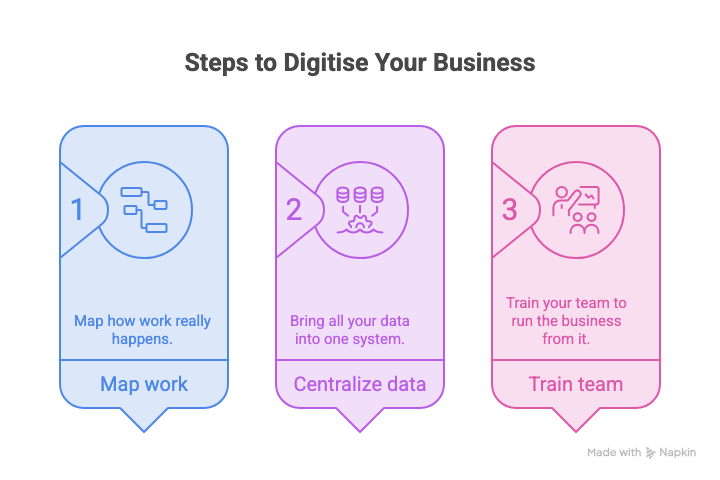
You can digitise your business in three steps: map how work really happens, bring all your data into one system, and train your team to run the business from it.
Many owners delay digitisation because it sounds expensive, technical and disruptive. It is easier when you stop thinking of it as one giant project and treat it as three clear steps, each building on the last.
Business digitisation does not mean buying gadgets or building an app. It means that the information running your business, such as orders, stock, payments, salaries and customer follow-ups, is recorded and used digitally, every day, by every team.
Step 1: Map your processes and decide what to track
Start on paper, not on a computer. Before you choose any software, write down how work actually flows in your business today.
Follow one order from start to finish. Who takes the enquiry? Who prepares the quotation? How does stock get reserved, dispatched and billed? Where does the payment get recorded? You will quickly see where information is repeated, lost or kept in one person’s head.
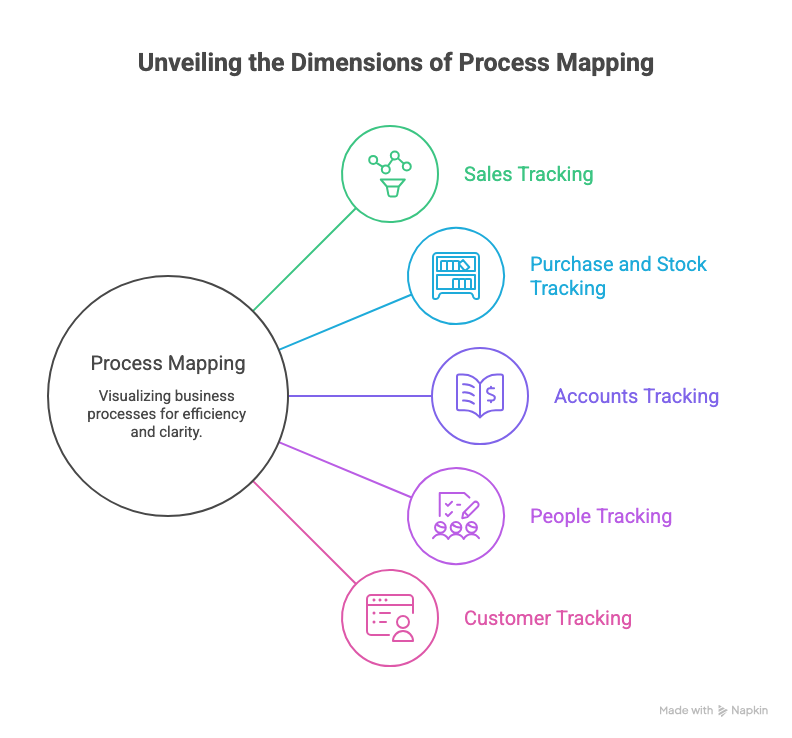
Then decide what you need to track:
- Sales: enquiries, quotations, orders, invoices and receipts
- Purchase and stock: suppliers, bills, items, batches and balances
- Accounts: ledgers, taxes, receivables and payables
- People: attendance, leave and payroll
- Customers: contacts, follow-ups and history
This step costs almost nothing and makes the next step far cheaper. A system built on a clear process works. A system built on confusion only digitises the confusion.
Step 2: Put all your data into one system
The second step is to implement one system that records everything in your map, and for most businesses that system is an ERP.
Enterprise Resource Planning software connects sales, purchase, inventory, accounts, HR and customer data on one platform. Every transaction is entered once and is visible to everyone who needs it. There are no separate spreadsheets, no duplicate entry and no waiting for month-end to know where you stand.
A few rules make this step work:
- Go live with core modules first. Sales, purchase, inventory and accounts cover most of the daily work.
- Clean your data before you move it. Duplicate customers and wrong item codes should not travel to the new system.
- Choose a partner who knows your industry. A textile unit and a trading firm run very differently.
- Consider open source. An open-source ERP such as ERPNext has no per-user licence, so growing your team does not raise your software bill.
Step 3: Train your team, adopt the system and improve with data
The third step is where digitisation pays off: your people use the system every day, and you use its data to decide.
Software that nobody uses changes nothing. Give each team hands-on training for their own work, name one person they can ask for help, and have leadership use the system’s reports in every review meeting. When the owner asks for numbers from the system and not from a phone call, the habit spreads quickly.
Once the data is flowing, start using it:
- Check dashboards weekly: sales, stock, receivables and expenses at a glance
- Spot problems early: slow-moving stock, late payments, repeated returns
- Improve processes every quarter: remove steps that add no value and add reports your team actually needs
Digitisation is not a one-time event. Each quarter, the business should run a little smoother than the last.
Common mistakes to avoid
Most failed digitisation projects fail for the same few reasons, and all of them can be avoided.
- Starting with software: Choosing a tool before understanding your own process
- Doing everything at once: Switching on every module together overwhelms the team
- Skipping training: Staff go back to spreadsheets when they feel lost
- Ignoring data quality: Old errors become new errors in the new system
- Treating go-live as the finish line: Without regular review, the system drifts and trust falls
Take the first step this week
Map your processes, bring your data into one system, and train your team to run the business from it. Three steps, done in order, turn digitisation from a worry into a plan.
If you want help with any of the three, Khatavahi BI Solutions works with businesses across textiles, diamonds, manufacturing and trading to map processes and go live with ERPNext. Write to us at jigar@khatavahi.in.